
Your First Card Battle
Build a deck, then learn to reveal, move, and attack your way through a first match.
On this page
What are you trying to do?
Each player brings creations to a 8 × 4 board. The pieces start face down. Reveal information, move your own pieces, and defeat every piece on your opponent’s side.
Link a Google account before joining a battle.
Build a deck
Open the card-battle deck editor and choose 10 main cards, with 2 of each of the five elements. Having enough cards is not sufficient; the element mix must also be valid.
Cards in your deck must be in your bag. Each main card also has 4 charge slots for support skills. Start by learning your main cards, then read Charges, hidden attacks, and ultimates. Save your deck, then return to the lobby to create a room or join a match.
Read the covered board
The starting board contains both players’ pieces and empty spaces. A covered square does not show whether it holds your piece, your opponent’s piece, or nothing. Revealing an opponent’s piece makes it visible too, so each reveal changes what both players know.
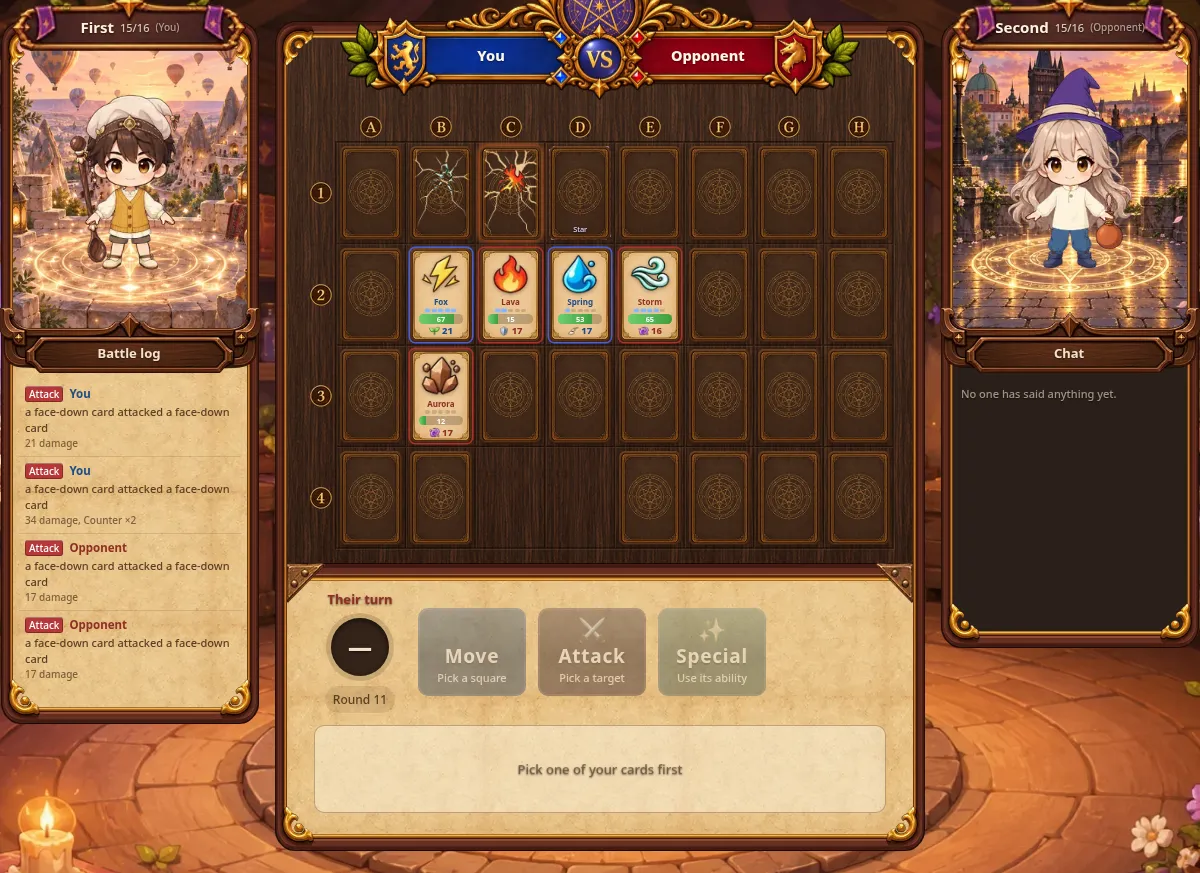
Pick one action on your turn
- Reveal: Choose a covered square to show a piece or an empty space. Revealing an empty space still uses your turn.
- Move: Choose one of your revealed pieces, then an adjacent empty square it can move to.
- Attack: Choose one of your revealed pieces, then an adjacent target it can attack.
- Ultimate: Use a piece’s skill when its spirit and the target meet the requirements.
Check the available squares highlighted on screen. If you cannot select a target, check whose turn it is, distance, elements, and skill requirements.
Check the elements before attacking
Fire beats Wind, Wind beats Earth, Earth beats Lightning, Lightning beats Water, and Water beats Fire. A matchup advantage multiplies damage by 2.
You cannot use a normal attack on a revealed opponent whose element beats yours, and your ultimate’s damage against it is blocked too. Reposition or send another piece. Hidden attacks follow different rules; see Hidden attacks.
How does a match end?
Defeat every opposing piece or make your opponent forfeit to win. A player also loses after 3 of their own turns without an action. Keep an eye on skipped turns caused by timeouts or disconnections.
If both sides are eliminated at the same time, the match is a draw. Battles are recorded, but wins do not award coins.
When creating a room, choose a turn timer from 20 to 60 seconds, or turn the timer off. A more generous timer can help while you learn.
Next: learn your skills
Revealed pieces regain spirit on your turn. At 5 spirit, they can use an ultimate. Read Advanced battle rules for charges and hidden attacks, or browse the effects in the Skill list.
Up nextCharges, Hidden Attacks, and Ultimates →